Photo: Abdulrosheed Bushroy
‘Tunji Solomon

*Art Review*
THE STAGE is perfect in its flaws. That’s what Prof. Oloruntoba Oju – the director of the play, wants the audience to believe and lived in throughout the stage performance. Thanks to the characters that give life to the scripts in form of chaos and courage that reign through the bottled frustration, triggered by the insensitivity of the privileged ruling class and their oligarchy nature. Beyond obscurity, the ruling class will continue to suffer bad press as long as the common man – (who Frantz Fanon refers to as the Wretched of the Earth) faces adversity and penury. Such fear is closer than hope for a better nation.
BETWEEN THEATRE as revolution and theater as an entertainment which Hubert Ogunde pioneered, there is a need for a delicate balance to be struck. The audience, like Oliver Twist, and Theater Art Department, Ladoke Akintola University of Technology (LAUTECH), Ogbomoso, did not fail to live up to expectations once again, as they transform the play to drama in form of Prof. Femi Osofisan’s evergreen Morountodun; being part of the outlined activities for LAUTECH’S 18th Convocation.
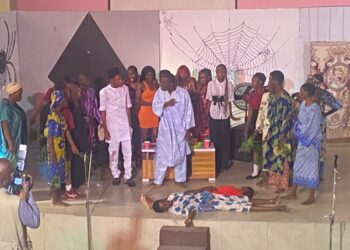
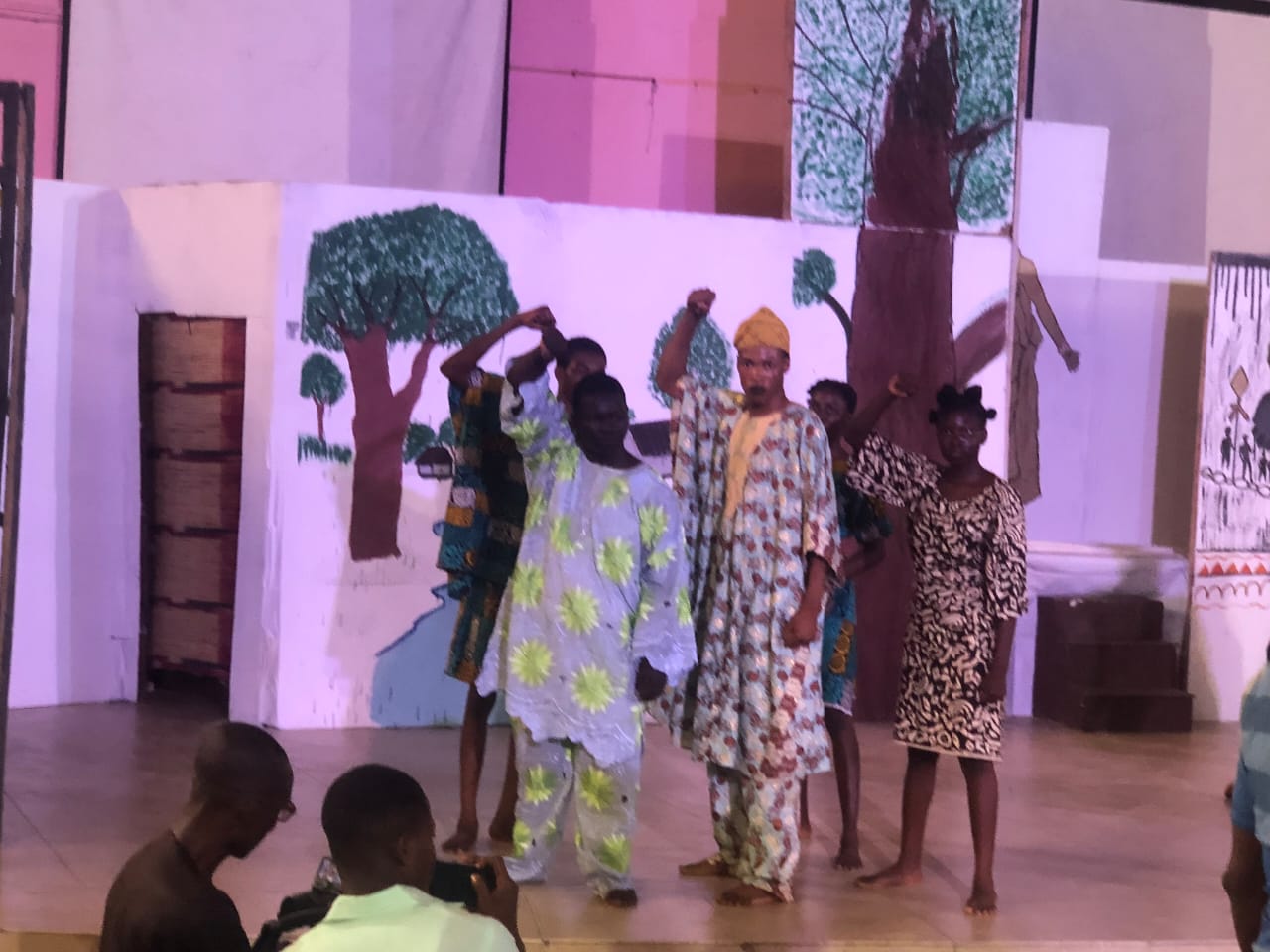
LIKE THE past that refuses to die, Prof. Osofisan’s Moroutodun not only takes us to the storyline of Agbekoya uprising of 1960s – where and when peasants and oppressive governance, had encounter. The thematic occupation of the play not only brought about the roles of women in every nation’s journey to nationhood. Dominantly, once again, the women take the centre stage in confrontational manner, especially Alhaja Kabirat (Niniola Olatunji/Olushola Ogunshola) and her daughter Titubi (Oluwanifemi Olawoyin/Rachael Abiodun) – with her retinue of male and female supporters, unleashed the past upon the audience to x-ray the present; which eventually sets the tone for the remaining scenes.
THOUGH the play revolves within the context of myths and legendary roles of Moremi, the audience attention was not only soaked in the exceptional roles played by Titubi during Agbekoya era. Titubi’s attempt to be captured by Agbekoya militants not only aided her quest to get back at the group, but probably put an end to the recurring militancy. This is an apt replica of Moremi Ajasoro’s result-oriented effort that led to the ceased invasions of Ile-Ife by the Igbo.
LIKE EVERY climax in a play, Titubi’s ambition materialised as she is able to present the mastermind of Agbekoya to the ruling government. Though not without warning: “You can’t win a war against the people whose course is just”, says Titubi.
In its denouement, Moroutodun’s conflict resolution is laid bare through the subtle attempt to stir audience into courageous act, self-belief and erased doubts; which Moremi’s courageous rare act, inspired psychological model,and bold steps in taken action against the recurring Igbo invasion; served as catalysts to resist the oppressive governance and hold their destiny in their hands.
LIKE AN unfinished business, it is never enough to give up on the face of challenges and difficulties. This is equally buttressed by Prof. wole Soyinka’s famous book: The Man Died. Yes! The man dies in you when you keep silent in the face of a tyrant. The gods have their roles to play, you have a role to play! The conversation that ensued between Niniola and Moremi attests to the desired mindset Titubi wants her people to have:
“Niniola (Promise Adeagbo/Mercy James): The gods are with us
Moremi (Omosewa Ajiboye/Emily Joshua): With their backs turned to us
Niniola: The gods will never turn their back! May the afternoon never suddenly take on the shroud of night in our life!
Moremi: Futile prayers! How many times already we’ve watched our festivals change into periods of mourning when the Igbos set on us? Yet, we have made sacrifices upon sacrifices till the earth is glutted with blood. Our priests have scraped their throats hoarse on incantations, and their latest ploy is to try and make us accept defeat as fate. Tell me, my friend, what more shall we do to learn that the gods will not help us? I have decided. Moremi shall be the clay which the race requires to remolds itself.
Niniola: You frighten me, Moremi. You repudiate the gods. . . .
Moremi: (amuse) Come, Nini. Embrace me. I am glad you came and talked to me. . . . Your doubt and your fear have strengthened me. I shall go, and I shall return. . .”.
OBVIOUSLY, REALITY is a important being. It has been established time and time again that the courage of a woman cannot be tamed in the quest for her heart desires. Where COURAGE exists, REVOLUTION is imminent. As a result, OPPRESSION cannot live long. Where FRUSTRATION triggers CHAOS, courage is always at the forefront! These are the few themes the playwright wants the audience to chew over.
NOTABLY, AFTER 43 years Moroutodun won the first edition of Association of Nigerian Authors (ANA) award for Literature, like Sharon Creech’s The Wanderer, the play has travelled across the nation and continues to play itself out into our socio-cultural cum political significances, like a cat with nine lives. Such is the usefulness Morountodun has on Nigeria, and by extension Africa, that continue to be suppressed by internal and external forces like oppressive governance, under-development, banditry, kidnappings, among others. Insightful, the play holds the toga of traditional and mythological traits, but there is high temptation that it cuts the edge of satire and used it in the sewing of its clothes. While Moroutodun takes us back to revolutionary journeys to redemption, can women act in unison to save the nation from the current leadership failure?
THOUGH THE reviewer cannot but note that Superintendent (Olayinka Adeleye/Michael Nwankwo) symbolically represents the ruling government, and mingles between the privileged class and the calling of his job. Similarly, Marshal (Damilare Michael /Ayomiposi Ige) captures the epitome of an individual who desires results, not words. Though like John Pepper. Clark’s The Casualties, the struggle consumed him like others in our history. Moreover, the duo of Baba (Okikiola Ismael/Timilehin Adeniyi), like every leader of a visionary camp, loves diplomacy and tolerates others, and Lawyer Isaac (Quyyum Ogunrinde/Deborah Oladepo) remains the familiar face Nigerians have seen as constant government’s ‘errand boy’ – a stooge government deployes for the implementation of obnoxious policies. We can all relate to such policies. Kudos must be given to the entire cast for being able to give a good account of themselves, through sustained tempo, maximised stage and coordinated transition. Technical care should be given to voice projection and out put in subsequent productions.
The Head, Theater Arts Department, Prof. Oloruntoba Oju cannot but appreciate the support of University Management ably led by the Vice Chancellor, Prof. Tom Kalilu, the Dean, Faculty of Arts and Social Science (FASS), Prof. Temisan Ebijuwa, and the guests in person of Emeritus Professor Femi Osofisan, MNOR; Dr. Alex Usifo and the veteran actress, Madam Joke Silva, MFR. Creativity always continues from where it stopped. See you again!
You can get every of our news as soon as they drop on WhatsApp ...To get all news updates, Join our WhatsApp Group (Click Here)