BREAKING

Current Events and News

Makinde Presents ₦1.12trn 2027 Budget, Earmarks 60% for Capital Projects


...To get all news updates, Join our WhatsApp Group (Click Here)

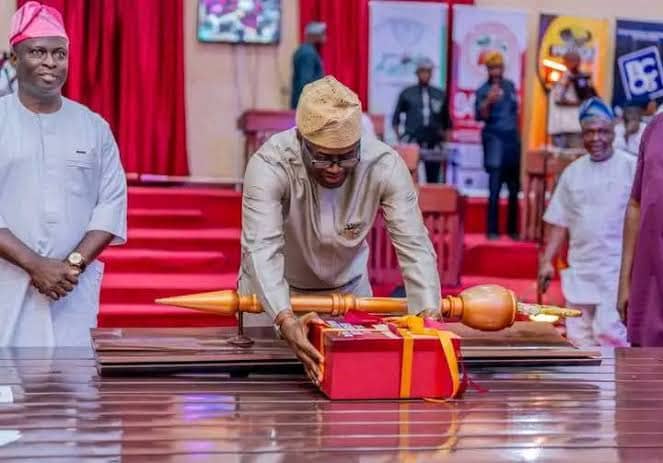
Oyo State Governor, Seyi Makinde, on Tuesday presented a proposed budget of ₦1.12 trillion for the 2027 fiscal year to the State House of Assembly, describing it as the Budget of Sustained Progress, aimed at consolidating his administration’s achievements and sustaining the state’s development trajectory.

The proposed budget, which stands at ₦1,115,341,378,359.94, is expected to prioritise capital investment, infrastructure development and the delivery of essential public services across the state.

Presenting the estimates before lawmakers, Makinde explained that the proposal was informed by consultations with stakeholders and residents across the state’s administrative and political zones, adding that their needs, concerns and expectations had been reflected in the government’s spending priorities.

According to him, ₦670,030,943,646, representing 60.07 per cent of the total expenditure, has been allocated to capital projects, while ₦445,310,434,739, representing 39.93 per cent, is earmarked for recurrent expenditure.

He explained that the allocation translates to approximately 60 per cent of every ₦100 proposed in the budget being committed to capital investment.

The governor, however, stressed that infrastructure development must be complemented by adequate investment in human resources and essential public services, noting that schools require teachers, hospitals need healthcare professionals, medicines and equipment, while public institutions must be adequately staffed and equipped to function effectively.

Also Read:  FAAN Probes K1 De Ultimate’s Airport Misconduct, NCAA Suspends Two Pilots Over Safety Breach

Makinde also emphasised the need to sustain his administration’s development policies beyond the expiration of his tenure, describing the proposed continuity agenda as Omituntun 3.0.

He expressed confidence that the candidates recommended to sustain his administration’s development philosophy would continue the vision, stressing that political differences should not be allowed to undermine the progress recorded in the state.

“While political parties may contest elections and some may emerge victorious while others lose, our overriding concern is to ensure that the development of the state does not suffer a setback,” he said.

He added that the continuity agenda would be presented to the incoming administration to ensure that the development process continued beyond 2027.

Earlier, lawmakers representing different constituencies across the state took turns to commend the governor’s leadership, describing his administration as visionary, inclusive and people-oriented.

The Majority Leader of the House, Sanjo Adedoyin, recalled the economic challenges confronting residents before the present administration assumed office in 2019, arguing that the situation had improved significantly under Makinde’s leadership.

Adedoyin said the economic hardship at the time was so severe that churches and philanthropists had to distribute food items to households to cushion its effects.

Similarly, Gbenga Oyekola commended the governor for infrastructural interventions in Oyo Federal Constituency, particularly the rehabilitation of roads connecting various communities and improving transportation and economic activities.

Another lawmaker applauded the administration for rehabilitating at least 26 inner roads in Ogbomoso, describing the projects as significant interventions that had improved mobility within the ancient city.

The lawmakers also acknowledged the state government’s investment in Ladoke Akintola University of Technology (LAUTECH), particularly the acquisition of sole ownership of the institution by the Oyo State Government, describing it as a major milestone in the state’s education sector.

Also Read:  BALE MASIFA OF OGBOMOSO, HIGH CHIEF GBADEBO OYEBODE ADEOBA, TRANSITS TO THE ANCESTRAL REALM By: Adewuyi Adegbite. The entire Ogbomoso community has been thrown into mourning following the transition of the Bale of Masifa, High Chief Gbadebo Oyebode Adeoba, a revered traditional leader, seasoned herbalist, and custodian of Yoruba heritage. High Chief Adeoba, who passed away at the ripe age of about 85 to 90 years, was widely respected not only for his traditional wisdom but also for his deep knowledge of Ifa divination. His passing marks the end of an era for the Masifa community in Ogbomoso and for the traditional institution as a whole. Having known him for decades as a close friend of my late father, I recall that during my father’s lifetime, he often purchased planks from him. Following my father’s demise, Baba Adeoba continued to maintain a cordial relationship with me, sustaining a friendship that had spanned generations. It was, therefore, with deep sorrow that I received the news of his transition to the land of the spirits. Though his death calls for celebration, given his age and achievements, it is always difficult to part with a loved one. In the Yoruba worldview, however, such a man is not considered dead but rather transformed into an ancestor. As a monarch and traditionalist, Bale Adeoba lived a fulfilled and exemplary life worthy of emulation. A professional herbalist and seasoned Babalawo, he was deeply versed in the Odu Ifa corpus. His expertise in divination took him beyond Nigeria’s borders to South America, particularly Brazil, where he not only practiced Ifa divination but also lectured adherents on its rudiments. Masifa, the community where he reigned, holds a unique historical position in Ogbomoso’s evolution. It was one of the 143 towns and villages that converged in Ogbomoso during the early 19th century as part of a strategic move to ward off invasions from Ilorin and other enemies following the fall of Oyo-Ile, the capital of the ancient Yoruba Empire. The Masifa people originally migrated from present-day Osun State, specifically the Ejigbo Local Government Area. Other towns that migrated alongside them included Agurodo, Isudunrin, Ola, Aye, Iwata, and Opete. While many of these towns later returned to their original settlements after hostilities ceased, some—like Masifa, Agurodo, and Olorasoko—remained in Ogbomoso, duplicating their traditional institutions but maintaining familial and cultural ties with their homesteads. I had the privilege of interviewing Baba Adeoba some years ago while gathering materials for “The Genesis: The History of Okeelerin,” authored by His Majesty, Oba S. B. Amao, the Aale of Okeelerin. During the interview, I asked him how their ancestors came to settle in Ogbomoso from Masifa-Ile. When I jokingly suggested that they might have sought refuge during the Fulani invasion, the outspoken monarch was quick to correct me. He vehemently debunked that claim, insisting that the Ilorin war never reached Masifa or its environs. He asked rhetorically, “How could the war that did not affect Ejigbo, which is only a few kilometers from Masifa, reach us? Did the Ilorin army use fighter jets to bypass Ejigbo and strike Masifa?” According to him, a prominent Oba in the Oyo Empire had invited their forebears, along with other communities, to settle in Ogbomoso as a strategic military move to defend the remnants of the empire from Ilorin’s incursions after the fall of Oyo-Ile. He also challenged the popular historical account of the 1835 Eleduwe War, often attributed to Oluewu and his Ibaruba ally. He asserted that his ancestor, Alajiki, for whom a major street in Masifa is named, actually led the war. His submission revealed the shortcomings of historians who rely on limited or single sources of information. Baba Adeoba further explained that if their people had indeed fled to Ogbomoso as refugees, they would not have had the confidence to settle at the outskirts of the new town—close to Ilorin’s frontier—where communities like Agurodo, Alapa at Taraa, Ajaawa, Ayegun, Osupa, and others were strategically positioned as defenders. “These towns,” he emphasized, “did not run from war; they formed the protective shield of Ogbomoso.” His position aligns with the account of Reverend N. D. Oyerinde in his classical text, “Iwe Itan Ogbomoso,” which acknowledges the military significance of these frontier settlements. Despite lacking formal Western education, High Chief Adeoba was a man of great native intelligence, courage, and decisiveness. As a ranking chief under the Soun dynasty, he was exceptionally loyal and humble. While many sought beaded crowns and undeserved titles, he proudly bore the simple but dignified title of Bale Masifa. During his reign, Masifa witnessed remarkable progress. He mobilized indigenes at home and abroad—including notable figures such as L. A. Gbadamosi, Justice Afolabi Adeniran, Barrister Dapo Atanda, Hajj Rasak Gbadegesin Kareem, and Hon. Wumi Ladeji—to contribute to the community’s development through the Masifa Progressive Union. Beyond his developmental strides, Bale Adeoba elevated the spiritual and cultural stature of Masifa through his mastery of Ifa. He will be remembered for his cordial relationship with all Ogbomoso monarchs, his detribalized nature, his patriotism, and his commitment to sustaining the bond between Masifa in Ogbomoso and their ancestral home in Osun State. I extend my heartfelt condolences to Oba Ghandi Afolabi Olaoye (Orumogege III), the Soun of Ogbomoso, members of the Soun-in-Council led by High Chief Otolorin, other Soun High Chiefs, the Aale of Okeelerin, Oba S. B. Amao, the Aresa of Iresa (Pupa), the Onpetu of Ijeru, Oba Sunday Oladapo Oyediran (Lagbami Osekun III), members of the Masifa Progressive Union, indigenes of Masifa at home and in the diaspora, the Ola Aresa of Masifa, and particularly the Adeoba Royal Family, on the passage of this illustrious patriarch. May the ancestors receive him with open arms, and may his legacy of wisdom, humility, and progress continue to inspire generations to come.

Other legislators highlighted improvements in infrastructure, education, healthcare and public welfare, while commending the governor’s emphasis on meritocracy and the creation of opportunities for individuals without established political connections to occupy positions of responsibility.

The proposed 2027 budget comes against the backdrop of an expanded 2026 fiscal provision.

The state’s original 2026 Budget of Economic Expansion stood at ₦891,985,074,480.79, with ₦502,846,477,812.85, representing 56.37 per cent, allocated to capital expenditure, while ₦389,138,596,667.94, representing 43.63 per cent, was earmarked for recurrent expenditure.

However, following the approval of a ₦210 billion supplementary budget by the State House of Assembly in September 2026, the total financial provision for the 2026 fiscal year increased to ₦1,102,085,074,480.79.

If approved, the 2027 budget will provide the financial framework for the final phase of Makinde’s administration, with emphasis on infrastructure development, stronger public institutions, improved service delivery and the consolidation of achievements recorded since 2019.


You can get every of our news as soon as they drop on WhatsApp ...To get all news updates, Join our WhatsApp Group (Click Here)


Leave A Reply

Your email address will not be published. Required fields are marked *

Related Posts

Load More Posts Loading...No More Posts.